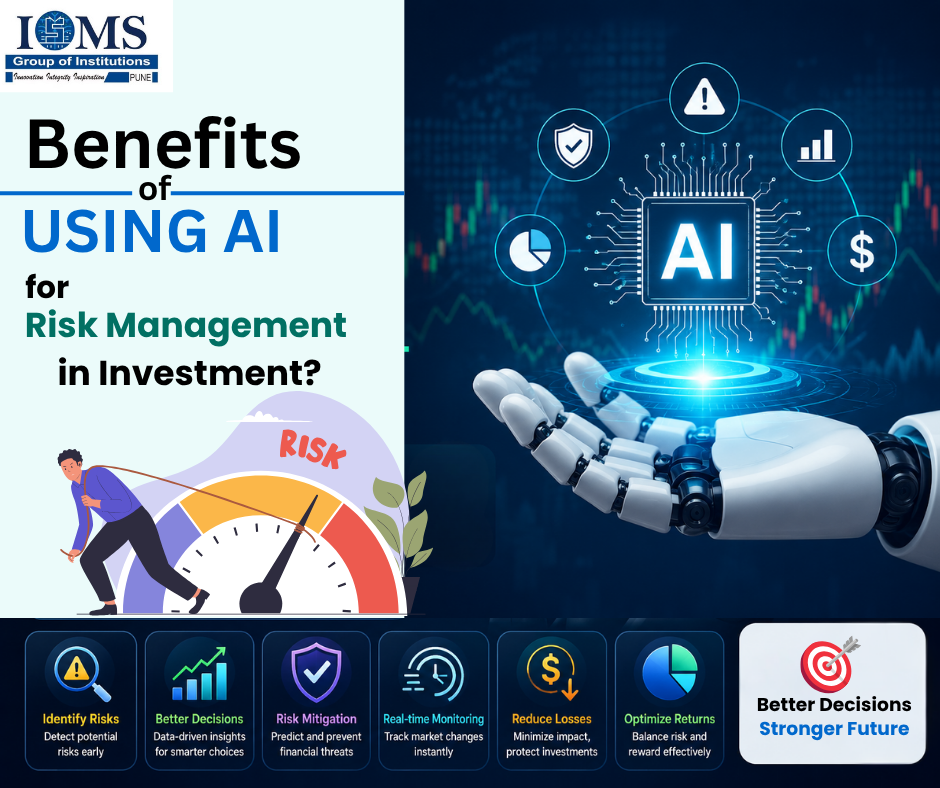
Every investment comes with some level of risk.
- Markets fluctuate
- Borrowers may miss repayments
- Regulations can change suddenly
The ever-growing amount of financial data makes it challenging for professionals to keep up without advanced technology.
This is why AI in finance has moved from being a buzzword to being a business necessity. Across the globe and right here in
- Indian financial institutions
- Investment firms
- Management professionals are turning to artificial intelligence to manage risk smarter
Faster, and more exactly than ever before.
At the International School of Management Studies (ISMS Pune), we train our students to work confidently in this AI-driven financial world. Understanding how AI reshapes risk management is not just academic it is a career skill that every finance and MBA student needs today.
In this blog
- We break down exactly what AI does in investment risk management
- The real benefits it delivers
- Why this knowledge matters for your professional future
What You'll Learn
- What AI in finance means in practice
- The key benefits of AI for investment risk management
- How AI handles fraud, credit risk, compliance, and portfolios
- Why ISMS Pune integrates this knowledge into its MBA curriculum
- Career paths that open up when you understand AI and finance together
What is AI in Finance?
Let us start with a clear description before we dive into the benefits.
AI in finance refers to the use of
- Machine learning
- Deep learning
- Natural language processing
- Predictive algorithms to analyze financial data
- Detect patterns
- Automate decisions
- Support smarter investment choices
Think of it this way. Traditional analysts can study a bulk of data points at a time. An AI system can all together analyze thousands of
- Market signals
- News articles
- Transaction records
- Macroeconomic indicators and produce insights in real time
That speed and depth of analysis is what makes artificial intelligence in finance and accounting such a powerful force in modern risk management.
Why Investment Risk Management Needs AI
Every investment carries risk.
- The stock you buy today may lose value tomorrow
- A borrower may default
- A change in interest rates
- A political shock
- An unexpected earnings announcement can move markets in minutes
Traditionally, experts manage investment risks using rule-based models based on historical data.
- Although these models delivered useful insights
- They were slow to respond
- Lacked the flexibility to keep up with changing market conditions
AI in finance solves this by doing something traditional models cannot:
- Learning from new data continuously
- Identifying relationships between variables no human would think to look for
- Flagging risk signals the moment they emerge not days later
This shift is not a small improvement. It is an essentially different way of thinking about risk.
The Key Benefits of AI for Risk Management in Investment
Faster and More Truthful Risk Detection
One of the most instant benefits of AI in finance is speed. Risk does not wait for your morning report. By the time a human analyst reviews overnight data and writes a summary, the market may have already moved.
AI-powered projecting analytics allows financial institutions to anticipate potential risks with high Accuracy. Machine learning algorithms analyze vast datasets to identify patterns and trends that may indicate future financial downturns and they do it continuously, around the clock.
Risk signals that once took days to surface through manual analysis can now be flagged within seconds. For investors, there is a difference between acting before a problem hits and reacting after the damage is done.
Predictive Market Analysis
Traditional risk models are backward-looking. They study what happened in the past and extrapolate from there. The problem is that markets do not always repeat themselves neatly.
Artificial intelligence in finance and accounting takes a different approach.
AI models combine historical data with real-time signals
- Interest rate changes
- Global news
- Currency movements
- Social media opinion
- Continuously update their predictions as new information arrives
This gives investors a clearer, more current view of what is likely to happen next, not just a summary of what has already occurred. For portfolio managers and investment analysts, this kind of forward-looking intelligence is enormously valuable.
Smart Portfolio Management
- Building a resilient investment portfolio means balancing risk and returning across assets
- Industries
- Geographies in a way that holds up even when markets get volatile.
- AI models assess asset correlations
- Market trends
- Risk factors to identify optimal allocations that balance risk and return
They track market conditions in real time and suggest modifications to mitigate potential losses before they appear.
This kind of continuous, intelligent portfolio monitoring was once the exclusive domain of large institutional investors with massive research teams. AI in finance is making it accessible to a much wider range of firms and the MBA specialists who know how to use these tools are increasingly in demand.
At ISMS Pune, our program confirms students understand not just the theory of portfolio management but the AI-driven tools that are transforming into practice.
Superior Fraud Detection
Fraud is one of the most costly and disruptive risks in any financial system. It damages
- Institutions financially
- Erodes trust
- Can take years to fully recover from
AI has become one of the most powerful tools available for detecting fraud before it causes serious harm.
- AI systems monitor transaction patterns continuously
- Learning what normal behavior looks like for each account
- Institution
- Market segment
- When something deviates from that pattern
- Unusual timing
- Unexpected transaction sizes
- Unfamiliar locations the system flags it for immediate review
The more data the system processes, the sharper its detection becomes. Traditional rule-based cheating filters catch what they are told to look for. AI Caught what it has learned to recognize including entirely new patterns of fraudulent behavior that no human analyst has seen before.
Better Credit Risk Assessment
When a bank or investment firm extends credit, the key question is always: how likely is this borrower to repay?
Traditional credit scoring Uses a limited set of inputs income, credit history, existing debt. Reliable, but incomplete.
Artificial intelligence in finance and accounting expands this picture dramatically.
- AI models analyze spending patterns
- Cash flow behavior
- Sector trends
- Broader market conditions alongside traditional credit data
The result is a more complete, more accurate picture of credit risk leading to smarter lending decisions and fewer defaults.
This benefit extends to investment decisions too.
- When evaluating fixed-income securities or lending-backed assets
- AI-powered credit analysis gives investors a much clearer view of the underlying risk they are taking on
Real-Time Compliance and Regulatory Monitoring
Regulatory risk is one of the most underappreciated risks in finance. Laws change. New requirements are introduced. Missing a compliance deadline for submitting an incorrect regulatory report can carry
- Serious consequences
- Financial penalties
- Reputational damage
AI systems can track regulatory changes across
- Multiple jurisdictions simultaneously
- Flag potential compliance breaches before they occur
- Automatically generate accurate compliance reports
This frees up finance and accounting teams to focus on higher-value work while intensely reducing the risk of regulatory errors.
For students studying artificial intelligence in finance and accounting at institutions like ISMS Pune, understanding compliance automation is a directly job-relevant skill because every major financial employer is investing in it right now.
Improved Decision-Making at Every Level
Risk management is ultimately about making better decisions under uncertainty. That is exactly what AI is designed to support.
- When decision-makers have approach to real-time
- AI-generated risk assessments rather than outdated reports
- But instinctively their decisions improve across the board
- They can act faster
- With great confidence
- With a Clear understanding of both the upside and the downside of any choice
AI in finance supports this at every level of an organization:
- From the portfolio manager adjusting allocations
- To the CFO evaluating capital capability
- To the compliance officer reviewing transaction reports
Smarter Capital Allocation
Knowing where to deploy capital is one of the most resultant decisions any investor or institution makes.
- Should you enter a new market?
- Increase exposure to a particular sector?
- Reduce holdings in a volatile asset class?
- AI-powered capital division models estimate investment opportunities against available resources
- analyze potential returns and risks under different scenarios
- account for cash flow patterns and market conditions all at once
- This helps investors make more confident, better-informed decisions about where to put their money
This kind of thorough:
- Data-driven capital allocation used to require large, expensive research teams
- AI in finance is making it faster, more accessible, and more exact.
How AI in Finance Differs from Traditional Risk Management
It is worth being clear about what makes AI different not just faster.
Traditional risk models are rule-based. A human expert writes the rules:
- If interest rates rise by more than X
- Flag this as a risk
- The model follows those rules exactly
- The problem is that real-world risk rarely follows the rules neatly
- AI models are pattern-based
- They learn from enormous volumes of data and discover relationships that no human would think to program in
- They adapt continuously as new data arrives
- They improve over time with experience
This is not an incremental upgrade to existing methods. Artificial intelligence in finance and accounting represents
- A fundamentally different method to understanding and managing risk
- One that is increasingly essential in a world of fast-moving
- Data-rich financial markets
Who Benefits from AI in Finance?
The impact of AI in finance increases Throughout the entire financial ecosystem, not just the Great institutions.
- Individual investors benefit from AI-powered programs that offer
- Smarter portfolio recommendations
- Real-time risk alerts
- Financial advisors can analyze client portfolios more
- Thoroughly and provide more personalized
- Data-driven guidance
- Banks and lending institutions use AI to make more
- Accurate credit decisions
- Reduce the cost of loan defaults
- Regulators and compliance teams use
- AI to monitor transactions
- Detect suspicious activity
- Make sure firms are meeting their legal responsibilities
- Accounting and finance specialists benefit from AI-driven automation that controls
- Routine tasks freeing them to focus on analysis
- Strategy
- Client relationships
And increasingly, MBA graduates and management professionals who understand how to work with AI in financial contexts are among the most sought-after candidates in the job market.
Why ISMS Pune Trains You for an AI-Driven Finance Career
At the International School of Management Studies (ISMS Pune), we believe that tomorrow's finance professionals need more than traditional management skills. They need to understand how technology and specifically AI in finance are reshaping every aspect of industry.
Our MBA set of courses integrates real-world introduction to
- AI-driven financial tools
- Risk management frameworks
- Data-informed decision-making
- We bring industry experts into the classroom
- Take students into real corporate environments through industry visits
- Support every student through a structured placement journey from admissions through to final placement
When you study at ISMS Pune, you are not just learning finance theory. You are building the skills that employers in
- Banking
- Investment
- Consulting
- Fintech
are actively looking for today.
If you want to build a career at the intersection of management, technology, and finance, ISMS Pune is where that journey starts.
The Future of AI in Finance and Accounting
Artificial intelligence in finance and accounting will only become more central to how financial institutions operate in the years ahead.
Multi-agent AI systems are advancing rapidly in areas like trading
- Risk modeling
- Portfolio optimization
- Market simulation
- Quantum-improved AI is being investigated for complex stress testing and factor modeling
- The integration of AI into everyday accounting and compliance workflows is accelerating across every sector
The professionals who understand these tools who can work with them question them and apply their output wisely will be the ones leading the next generation of financial institutions.
FAQs
Q1. What is AI in finance?
Ans: AI in finance refers to the use of
- Machine learning
- Natural language processing
- Predictive analytics to analyze financial data
- Manage investment risk
- Detect fraud
- Support smarter decision-making
It helps financial institutions method vast amounts of data in real time and return to risks faster than traditional methods accept.
Q2. How does AI help with investment risk management?
Ans: AI helps by analyzing
- Real-time market data
- Detecting unusual patterns
- Predicting potential losses
- Recommend portfolio adjustments
It gives investors and institutions a more complete and up-to-date view of risk than traditional models can provide.
Q3. What is the difference between traditional risk management and AI-driven risk management?
Ans: Traditional risk management uses rule-based standards built on past data.
- AI-driven risk management uses machine learning to discover patterns in complex data
- Adapting to new information continuously
- Flag risks that traditional models would miss
Q4. How does AI detect fraud in investments?
Ans: AI monitors operation patterns constantly and learns what normal behavior looks like.
- When a transaction deviates from that pattern unusual timing
- Unexpected amounts
- Unfamiliar locations the system flags it immediately
- The system improves its detection accuracy as much as data it processes
Q5. What skills do finance professionals need to work with AI?
Ans: You do not need to be a data researcher. But understanding
- How AI models work
- How to interpret their outputs
- How to apply AI-generated insights in real financial contexts is increasingly important
- Courses in financial risk management
AI in finance, like that offered through ISMS Pune's MBA program are directly applicable here.
Conclusion
Risk is necessary in investment. But poor risk management is a selection and with the tools available today, it is an unnecessary one.
AI in finance is giving
- Investors
- Institutions
- Management professionals
- A fundamentally better way to understand
- Respond to risk
- From smarter fraud detection to real-time portfolio monitoring to compliance automation, the benefits are real
At the International School of Management Studies (ISMS Pune), we are committed to making sure our students graduate ready for this world. Not just familiar with it, genuinely ready to lead in it.
If you want to build your career at the intersection of
- Management
- Finance
- Technology
Study what ISMS Pune has to offer. The future of finance belongs to those who understand it.